
 EN
EN
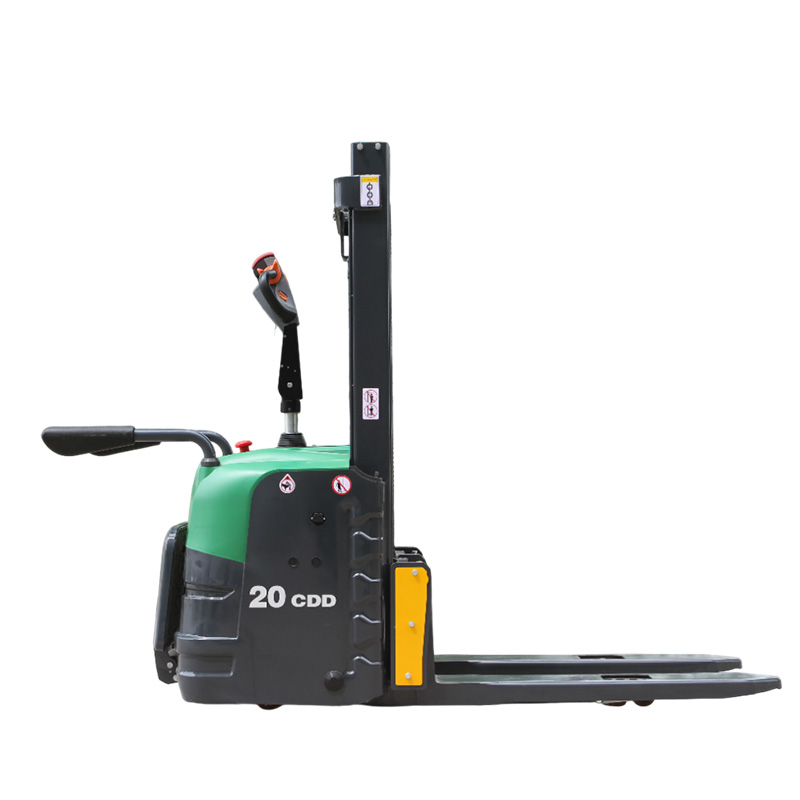
Understanding Electric Stacker Forklifts: Types and Core Functions
What Is an Electric Stacker Forklift?
Electric stacker forklifts run on batteries and handle both stacking materials vertically and moving them horizontally across warehouses. These machines fall under Class III in industry terms, which basically means they're electric powered and meant to be operated either by hand or while riding on them. Most commonly found inside buildings rather than outside, workers rely on them daily in places like big box stores, factories, and shipping centers where space is tight. What makes these forklifts stand out? They come equipped with hydraulic lifts that raise heavy items, sturdy backrests to keep loads secure during transport, and control panels designed for comfort during long shifts. With proper training, operators can safely move weights reaching around 3,000 pounds without breaking a sweat.
Common Types of Electric Stackers in Industrial Use
Three primary variants dominate warehouse operations:
- Walkie Stackers: Operator-guided units ideal for short-distance pallet movement, commonly used in low-throughput settings like small warehouses.
- Rider Pallet Stackers: Equipped with a standing platform, these enhance productivity in large facilities where travel exceeds 100 feet.
- High-Lift Stackers: Engineered for stacking up to 20 feet, these are essential in facilities with vertical racking systems.
Each model balances lift height (6—20 ft) and load capacity (1,500—5,500 lbs) to suit specific operational demands.
How Electric Stackers Differ from Traditional Forklifts
Electric stackers focus more on being able to move around tight spots and saving floor space rather than brute strength, which makes them great for those cramped warehouse aisles and small work areas. Compared to old-fashioned gas-powered forklifts, these electric models don't emit any pollutants at all. They also run much quieter too, staying under 75 decibels compared to the noisy 85-95 dB range of diesel versions. Plus, they eat up about 40 to 60 percent less electricity each hour of operation. Because they're built smaller, electric stackers can turn in circles that are up to 30% tighter than regular Class IV and V IC forklifts. And let's not forget about money matters either. Over ten years, companies typically spend between half to three-quarters less on maintenance when using electric models instead of their traditional counterparts.
Key Advantages of Electric Stacker Forklifts in B2B Operations
Electric stacker forklifts deliver measurable improvements in efficiency, safety, and sustainability, aligning with modern warehouse optimization goals.
Energy Efficiency and Lower Operating Costs
Electric stackers reduce energy consumption by up to 40% compared to IC models. Regenerative braking recovers power during deceleration, and lithium-ion batteries support 2—3 shifts on a single charge. Businesses typically save $12,000—$18,000 annually per unit due to lower electricity costs and eliminated fuel expenses.
Reduced Noise and Improved Indoor Air Quality
Electric stackers that operate under 75 dB(A) create work environments where people can actually hear each other talking amidst all the warehouse activity. Safety experts have noticed something interesting too. According to a recent 2024 study on materials handling, warehouses switching to electric forklifts saw around 31 percent fewer hearing problems reported to OSHA. And there's another benefit nobody talks about much but everyone feels. Without those exhaust fumes hanging around, these electric models cut down on tiny particles in the air called PM2.5 by nearly 98%. That means cleaner breathing space for workers throughout the day.
Environmental Benefits vs Diesel and Gas-Powered Models
With zero direct emissions, each electric stacker avoids 8—12 tons of CO₂ annually. Adoption supports corporate sustainability targets, enabling companies to achieve 18—22% faster ROI when replacing IC fleets. Research from supply chain analysts indicates a 65% reduction in carbon footprints for warehouses transitioning to all-electric material handling equipment.
Performance Metrics: Lift Height, Load Capacity, and Space Utilization
Lift Height and Load Capacity by Model and Application
Electric stackers come designed for specific jobs rather than one-size-fits-all solutions. The basic models typically manage around 2,000 to 3,000 pounds with lifting heights reaching about 12 feet, which works well enough for most retail warehouses. When we get into heavy-duty applications like manufacturing facilities, these machines step up their game considerably, capable of handling weights between 5,000 and 6,000 pounds while reaching heights beyond 18 feet. Take a look at those compact three-wheel stackers for instance. They might clock in at around 4,400 pounds capacity with 15-foot lift capabilities. That's generally sufficient for mid-sized online retailers storing boxes and packages, but falls short when dealing with automotive components that need stacking all the way up to 20 feet high. Warehouse managers know this stuff matters because getting the right equipment makes all the difference in daily operations.
Matching Electric Stacker Specs to Racking and Facility Layout
Selecting the right model requires alignment with physical constraints. Facilities with 10-foot racking and 60-inch aisles gain no benefit from 15-foot lift capabilities. According to the 2025 Warehousing Equipment Report, businesses that match load capacity to actual pallet weights reduce energy waste by 18%. Use this checklist:
- Weight: Ensure racking beams support 110% of the stacker’s maximum load
- Height: Add 6—12 inches to lift height for safe clearance
- Floor conditions: Narrow aisles require tighter turning radii (<60 inches)
Compact Design and Maneuverability in Narrow Aisles
Modern electric stackers excel in space-constrained environments. Units with retractable masts and rear-wheel steering achieve turning circles under 50 inches, allowing smooth operation in 60-inch aisles. A 2023 Logistics Efficiency Study showed that compact electric stackers increase pallet throughput by 22% compared to traditional counterbalance forklifts in tight layouts.
Total Cost of Ownership: Purchase, Maintenance, and Energy Use
Upfront Costs: Semi-Electric vs Fully Electric Stackers
The upfront cost of semi-electric stackers drops somewhere between 30 to 40 percent compared to their fully electric counterparts. These hybrid machines mix manual lifting with electric movement systems, making them attractive for budget-conscious operations. But there's a catch worth mentioning. The reduced level of automation means operators still need to put in significant physical work, which can actually drive up labor expenses over time. Looking at the numbers, fully electric models typically range from around $18,000 to $25,000 while semi-electrics fall in the $12,000 to $18,000 bracket. What makes the full electric versions stand out is their completely hands-off operation. Warehouse managers report seeing about a 62% drop in worker fatigue during peak periods when these machines are deployed. For small-scale operations where throughput remains low most days, the semi-electric option might make sense financially in the short term. However, anyone running an automated facility or dealing with consistently high demand will find that the total cost of ownership calculations favor the fully electric models hands down.
Long-Term Savings in Maintenance and Energy Consumption
The numbers speak for themselves when comparing electric stackers to their internal combustion engine counterparts. These electric machines typically consume around 40 percent less power, which translates into annual savings somewhere between $2,100 and $3,800 per unit when running two shifts. When it comes to upkeep, there's another big difference worth noting. Electric models have significantly reduced maintenance costs because they simply don't have as many moving parts to worry about. While traditional engines require monthly checkups, electric motors generally just need a quick lookover every three months or so. According to recent industry data from logistics technology experts, businesses that made the switch from diesel to electric stackers reported cutting their maintenance bills by approximately $740,000 over a three-year period for fleets containing about 120 units. Warehouse operators especially seem to benefit from these cost reductions.
Battery vs AC Power: Lifecycle and Replacement Costs
| Cost Factor | Battery-Powered Stackers | AC-Powered Stackers |
|---|---|---|
| Initial Investment | $1,200—$2,500 per battery | $4k—$7k infrastructure |
| Replacement Cycle | 3—5 years | 8—12 years |
| Energy Cost/Hour | $0.18—$0.22 | $0.14—$0.16 |
| Peak Shift Runtime | 6—8 hours | Unlimited* |
*Requires continuous facility power access
Lithium-ion batteries now lead in modern fleets, offering 35% faster charging than lead-acid types. However, 24/7 operations often favor AC-powered models to eliminate downtime from battery changes.
Selecting the Right Electric Stacker for Your Business Needs
Application Fit Across Retail, Manufacturing, and E-Commerce
Electric stackers come in different sizes to fit what various industries need. Retail stores often go for the smaller walkie versions when space is limited in those cramped back rooms and loading areas. Factories tend to pick models that can handle around 3k to 4k pounds, which works well for shuttling raw materials across production zones. For e-commerce warehouses dealing with massive inventories, high reach stackers that get up to about 20 feet tall are becoming really popular since they let companies pack more stuff vertically. According to a recent report from MHI in 2023, nearly seven out of ten logistics companies have switched to electric stackers at their parcel sorting facilities because these machines just work better with all the different products they handle at once.
How Facility Size and Throughput Influence Selection
For spaces where the aisles are tighter than 8 feet across, three-wheel stackers with chassis widths around or below 45 inches work best. These machines make turning corners and navigating tight spots about 40% easier compared to wider alternatives. Warehouses that handle over 500 pallets each day would be better off going with AC-powered units since they run continuously for between 8 to 10 hours without needing a recharge stop. This avoids all those annoying battery changes during operations. Smaller facilities that don't need equipment running constantly might consider semi-electric stackers instead. They cut down upfront costs by roughly 25 to 30 percent and still handle most lighter-duty tasks just fine. A recent logistics report from 2024 found that companies switching to these narrow aisle electric models saw their overall cycle times improve by nearly a quarter compared to traditional setups.
Step-by-Step Guide to Choosing the Optimal Electric Stacker
- Assess Load Profiles: Map 95th percentile weights—systems should handle 115% of peak loads to prevent oversizing
- Measure Vertical Requirements: Match lift heights to racking systems, adding 6—8” clearance for safe placement
- Audit Power Infrastructure: Sites without dedicated charging stations should consider lithium-ion models with 30-minute fast-charge capability
- Test Maneuverability: Confirm turning radius matches aisle width using manufacturer specs or on-site demos
Operators prioritizing rapid charging should evaluate lithium-ion-powered models, which offer 30% faster charge cycles than lead-acid systems based on 2024 Energy Commission data. Always verify that dealer service networks are within 50 miles to ensure emergency repair response within four hours.
Frequently Asked Questions
What is the maximum load capacity for electric stacker forklifts?
Most electric stackers handle loads between 1,500 to 5,500 pounds, depending on the model and its specific application.
Why are electric stackers preferred over traditional IC forklifts?
Electric stackers are favored for their reduced emissions, quieter operation, lower energy consumption, and better maneuverability in tight spaces.
What are the cost benefits of choosing electric stackers for my business?
Businesses save significantly on maintenance and energy costs, potentially reducing annual expenses by $2,100 to $3,800 per unit when operating electric stackers.
How do battery and AC-powered electric stackers differ in operation?
Battery-powered models generally have a runtime of 6-8 hours before requiring recharge, while AC-powered units can operate continuously without the need for battery changes.
What factors should I consider when selecting an electric stacker for my facility?
Consider the facility layout, aisle width, load requirements, lift height, and available power infrastructure when selecting the appropriate electric stacker model.
Table of Contents
- Understanding Electric Stacker Forklifts: Types and Core Functions
- Key Advantages of Electric Stacker Forklifts in B2B Operations
- Performance Metrics: Lift Height, Load Capacity, and Space Utilization
- Total Cost of Ownership: Purchase, Maintenance, and Energy Use
- Selecting the Right Electric Stacker for Your Business Needs
-
Frequently Asked Questions
- What is the maximum load capacity for electric stacker forklifts?
- Why are electric stackers preferred over traditional IC forklifts?
- What are the cost benefits of choosing electric stackers for my business?
- How do battery and AC-powered electric stackers differ in operation?
- What factors should I consider when selecting an electric stacker for my facility?